
Built on Progress. Focused on the Future.
At Bakelite, our 2030 goals are grounded in science, driven by innovation, and aligned with global sustainability frameworks. These goals reflect our commitment to environmental stewardship, social responsibility, and ethical governance.
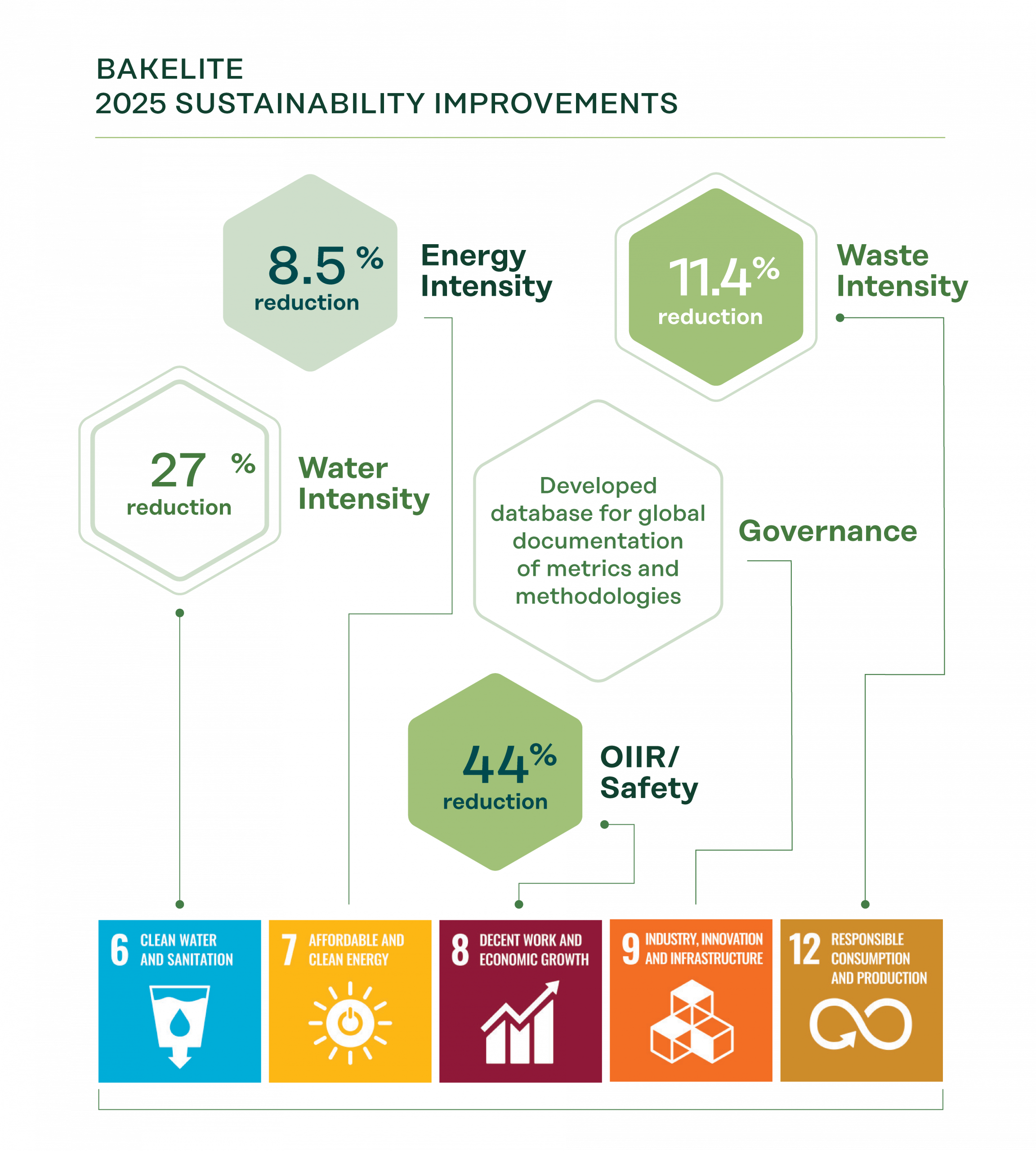
- Reduce energy intensity by 10%, against a 2023 baseline.
- Reduce water intensity by 10%, against a 2023 baseline.
- Reduce waste disposal intensity by 10%, against a 2023 baseline.
- Reduce Occupational Injury and Illness Rate (OIIR) to 0.5.
- Implement a sustainability management system (SMS) to measure, manage and report our progress in sustainability.

Our Environmental Sustainability Progress
We are reducing our environmental footprint through:

ENERGY STAR® Partner since 2023.


Site-specific water scarcity assessments and pilot water mapping projects.


Continued publication of verified Scope 1, 2, and 3 emissions.
We are designing safer, more sustainable products:
- Biorenewable Raw Materials:
Our recent acquisition of Sestech, with its 100% bio-based adhesives, provides us even more opportunity to design products with biorenewable raw materials. - Enabling Energy Efficiency:
Products like Bakelite Resi-BoostTM provide significant advantages in increased throughput, lower application rates, and energy savings while maintaining performance improving press times without any decrease in bond quality. - Reused and Recycled Content:
We aim to reuse and recycle by-product streams wherever possible. Responsible production benefits both the environment and business, when the maximum value is extracted from every molecule.
We are advancing circularity through:
- Waste Reduction: 10% reduction in disposal intensity by 2030. Focused efforts on reducing landfill waste and increasing recycling.
- Product Lifecycle Management: Exploring closed-loop systems with customers on packaging.
- Bio-Based Adhesives: Investing in adhesives which are 100% bio-based and designed to minimize environmental impact.
- Reused and Recycled Product Content: We are constantly seeking opportunities to reduce, eliminate, or recycle by-products. Responsible production benefits both the environment and business, when the maximum value is extracted from every molecule.
We are building a resilient, inclusive, and ethical organization:
- Associate Engagement
82% participation in the 2025 Voice of the Associate engagement survey. - Governance & Ethics
Bakelite achieved this rigorous ISO 27001 certification in 2025 - People and Belonging
Launched the Bakelite Women’s Network and Employee Resource Groups (ERG) framework in 2023. - ISCC+ Certified Bio-Formaldehyde
Shipped first batch of ISCC+ certified bio-formaldehyde (bio-HCHO)
Our Sustainability Aspirations
We believe in continuous improvement and have a longstanding history of viewing our work with a critical lens and striving to get better every day. It’s simply part of our DNA. This mindset extends to sustainability, which is not just a strategy or initiative, but a core part of our identity and purpose. Our commitment to sustainability is reflected in various aspects of our operations.

2030 Goals and Metrics
2030 GOAL |
2023 BASELINE |
2025 PROGRESS |
IMPROVEMENT |
|---|---|---|---|
|
Reduce energy intensity by 10%
|
0.471
|
0.431
|
8.5% Reduction
|
|
Reduce water intensity by 10%
|
2.893
|
2.005
|
30.7% Reduction
|
|
Reduce waste intensity by 10%
|
0.0176
|
0.0156
|
11.4% Reduction
|
|
OIIR < 0.5
|
1.2
|
0.67
|
44% Reduction
|
|
Implement a Sustainability
Management System
|
– Scope 1-3 greenhouse gas inventories
– 2030 Goals and targets
– Annual Reporting
|
Developed database for
global documentation of metrics and methodologies. |
Focus on Water
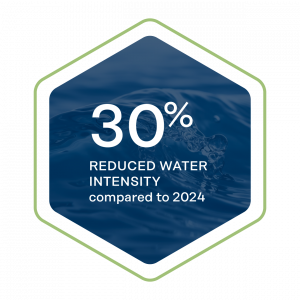
As the effects of water stress continue to be measured and felt in various geographies across the globe, we began using tools to help predict water stress at our sites. In 2025, our sites did their part, collectively reducing water intensity by 30.7% compared to our 2023 baseline. This proactive approach to understanding water at our sites has strengthened our long-term water resilience across multiple regions.
These efforts include:
- Rainwater collection and reuse
- Use collected stormwater
- Water recycling
Focus on Energy
In 2025, the Botlek, The Netherland site completed the first full year of steam-turbine operation transformed process-generated steam into electricity that now supplies up to 50% of the site’s total energy needs
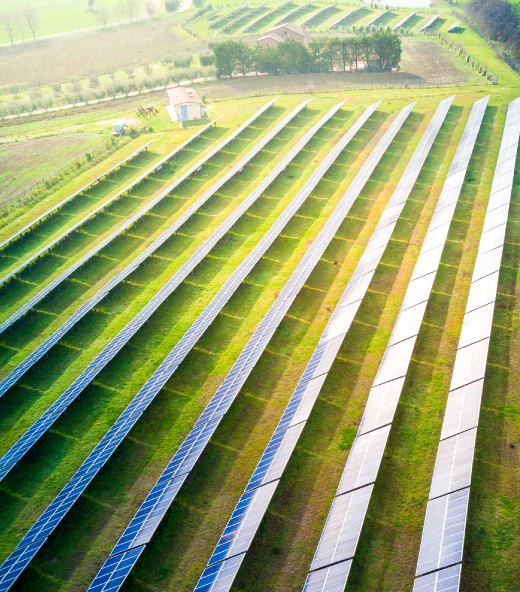
2025 also saw two on-site solar-panel farm installations at Barry, UK and Lantaron, Spain, and a power purchase agreement in Kitee, Finland. These projects supply up to 20% of each site’s electricity, with a corresponding reduction in Scope 2 carbon emissions.
Many small improvements across our plant sites led to an overall 8.5% reduction in energy use per metric ton of product produced from baseline.
Focus on Waste
Innovation in 2025 was driven by our workforce, resulting in a 11.4% reduction in waste intensity.
- Multiple sites utilize closed-loop reuse of empty raw material containers with external partners, reducing packaging waste and eliminating the need for landfill or incineration.
- In Albany, Oregon, the team enhanced segregation of rinse water to prevent stormwater contamination and
reduce wastewater generation. This upgraded system also provides better ergonomics for associates, making it a win-win project. footprint and superior performance.